
Tools and providers
Part of SEO tools for law firms: what UK solicitors need
SEO tools for law firms: what UK solicitors need
Compare SEO tools for UK law firms on SRA compliance, legal directory tracking and rank reporting for solicitor branches across England and Wales.
What to take away
- A single-office firm can start with Semrush or Ahrefs for keyword and competitor data, plus BrightLocal for its Google Business Profile.
- Firms running three or more offices should add AccuRanker or Sistrix so rankings are reported town by town rather than as one national figure.
- No product enforces SRA publicity or Transparency Rules for you. Buy the one that makes human sign-off easy to record.
- Entry-level UK list prices run from about £25 a month for local listings tools to about £200 a month for full SEO suites.
How firm size changes the shortlist
The useful comparison is not Semrush against Ahrefs in the abstract. It is which products cover your office count, your practice areas and your approval process. Our Ahrefs vs Semrush comparison for UK agencies sets out how the two suites behave when you test them on live client sites.
Main legal use
- Semrush
- Keyword research and position tracking
- Ahrefs
- Backlink checks and content gaps
- AccuRanker
- Daily rank tracking
- Sistrix
- Visibility tracking and SERP snippets
- BrightLocal
- Google Business Profile and citations
Legal-relevant test
- Semrush
- Tracking by town; exportable reports
- Ahrefs
- Directory links; API access
- AccuRanker
- Keyword groups per office
- Sistrix
- Visibility by region
- BrightLocal
- Per-branch profiles and review replies
Typical fit
- Semrush
- Single-office firms
- Ahrefs
- Firms with in-house marketing
- AccuRanker
- Multi-office firms
- Sistrix
- Regional competitors
- BrightLocal
- All local firms
Legal work narrows the field in two ways. A tool that cannot separate Leeds from Cardiff wastes money for a firm with branches in both. Content tools also need a permission structure showing who approved a regulated page.
Indicative UK pricing per tier
| Product | Entry tier | Mid tier | Priced by |
|---|---|---|---|
| Semrush | about £110 a month | about £210 a month | Users and projects |
| Ahrefs | about £24 a month | about £99 a month | Reports and credits |
| AccuRanker | about £100 a month | about £250 a month | Tracked keywords |
| Sistrix | about £85 a month | about £170 a month | Domains tracked |
| BrightLocal | about £25 a month | about £40 a month | Locations |
These are indicative list prices, exclude VAT and change often. Check current UK pricing before you commit.
What SRA publicity rules mean for tool choice
The SRA Standards and Regulations govern how firms in England and Wales publicise their services. The Transparency Rules, in force since December 2018, require published price information for certain matters. Scotland and Northern Ireland have separate regulators, so a workflow built for England and Wales may not suit a Glasgow or Belfast office.
Features worth paying for include approval workflows, user permissions, content history and scheduled publishing. A tool that drafts 40 practice-area pages in an afternoon still needs a qualified person to check every regulated claim.
Publicity rules follow the content, not the drafting method. A page written with a content tool carries the same obligations as one written by a partner.
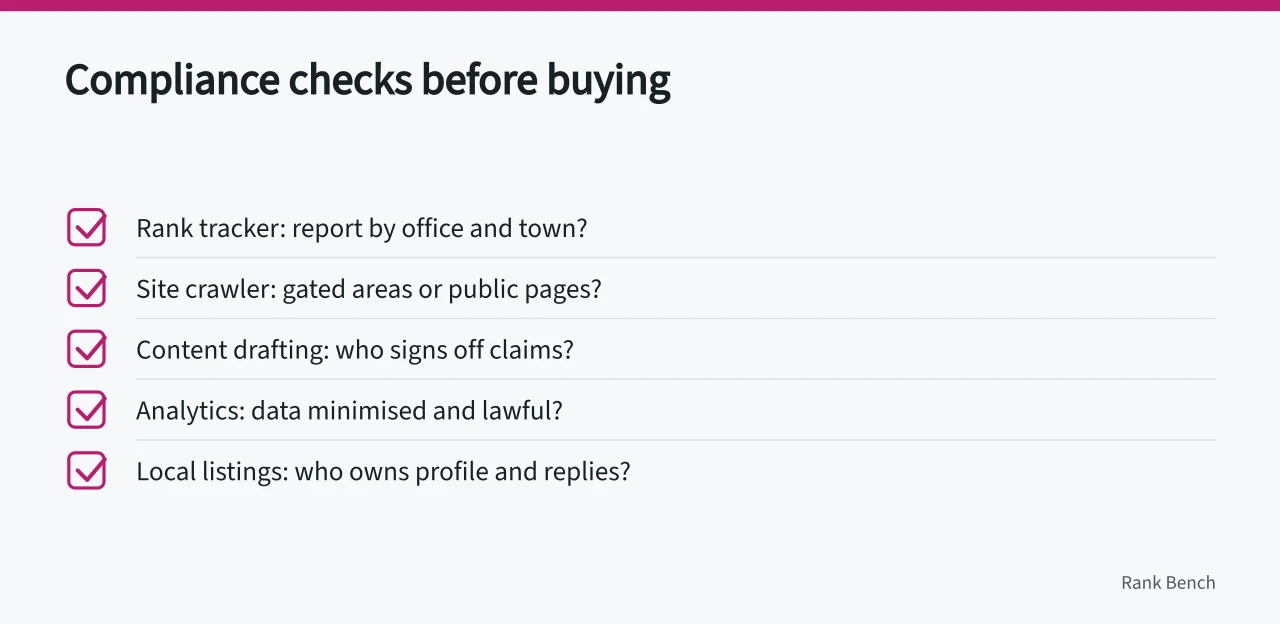
Connecting analytics to a site with enquiry forms means processing personal data. The ICO guidance on UK GDPR covers lawful basis, retention and individual rights, and those duties apply wherever the vendor sits.
Ask for evidence of information security management. ISO 27001 certification is a common benchmark, and a supplier that cannot describe access controls is a poor fit for client enquiries.
Example: ranking four offices without dashboard sprawl
A firm with offices in Leeds, Cardiff, Bristol and Southampton needs one tracked location per branch, plus any town where it wants new work. Track practice-area phrases such as "employment solicitor", not broad head terms.
Ranking four offices without dashboard sprawl
- Create a tracked location for each office and each target town.
- Group keywords by practice area rather than by head term.
- Assign one owner per office for monthly checks.
- Export everything into a single report for the partners.
Our local rank tracking guide explains how to structure that reporting town by town without drowning in dashboards. Review monthly, not daily: legal search volumes are low and daily movement is mostly noise.
Location-level rank tracking setup
- One tracked location per office
- Add towns where you want to grow
- Track practice-area terms that convert
- Review monthly, not daily
Judging Chambers and Legal 500 profiles
Directory rankings come from submitted work and referee feedback, not on-page optimisation. You cannot lift a Chambers or Legal 500 profile by editing keywords. What you control is the link, the description and the page it points to.
Tag profile links with UTM parameters, then compare referral sessions with the enquiries they produce. Judge each profile by enquiries, not by referral traffic alone. A profile that sends visits but no work usually needs a better landing page.
Claims you publish must be evidenced. The ASA advertising codes cover comparative and promotional claims, so keep records for anything you state.
Common questions
Do law firms need a legal-specific SEO tool?
No single product is built only for solicitors. Location-level reporting, exportable data and a workflow that fits your approval process matter more. A general rank tracker plus a listings tool covers most firms.
Can we use AI writing tools for practice-area pages?
Yes, but a qualified person must review every regulated claim before publication. The publicity rules apply to the content whoever or whatever drafted it.
How should we handle reviews and testimonials?
SRA publicity rules and the advertising codes both apply to claims you publish. Keep evidence for anything you state and get written consent before naming a client.
Who should own the tooling accounts?
Keep accounts in the firm's name so data and profiles survive a supplier change. Our guide to choosing an SEO tool for a small UK agency covers the seat limits and exit terms worth agreeing first.