

Operations
Part of When to audit SEO tool ownership and reporting routines
SEO tools team roles without buying seats first
A working list of SEO tools team roles, with inclusion criteria, a scoring rubric and the duties each seat should own before you sign a licence.
What to take away
- Map duties before you buy. A seat is justified when a named person owns a recurring task that needs the tool.
- Most small teams need two to four paid seatsa licence owner, an analyst and a technical owner.
- Check VAT, retention and processing locations before a trial becomes a contract.
- Label prices with their currency. US vendors bill in dollars, so a dollar list price is not your sterling cost.
Seat count by team size
A workable rule of thumb to apply before any trial:
- Two or three peopletwo paid seats. Merge the licence owner and the analyst, and buy crawl work as a one-off.
- Four to six peoplethree or four paid seats. Split operations from analysis, and give the content editor read-only rank tracking.
- Seven or more peopleone seat per named owner, usually five and up. Local SEO and digital PR then hold their own logins.
Viewer access often costs less than a full seat, so check that gap before adding a fifth licence. Our operations and delivery guide for SEO tools shows how to fold the seat list into a quarterly review.
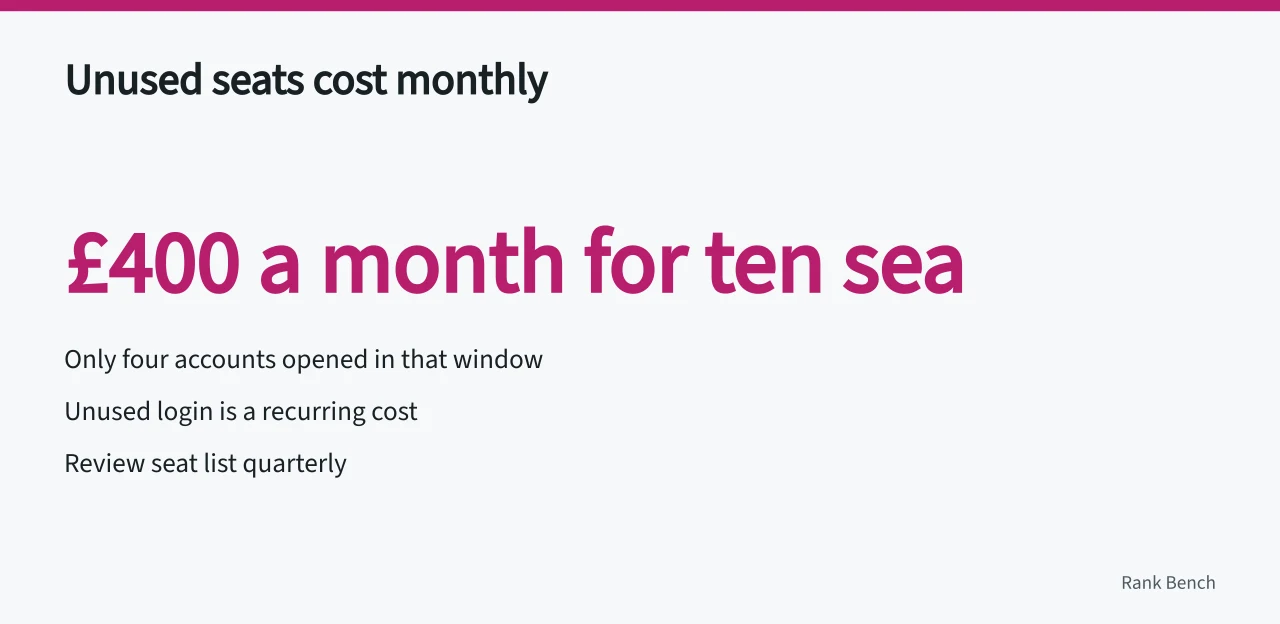
A team paying £400 a month for ten seats may find only four accounts were opened in the last 30 days.
Duties each role owns
- SEO operations managerholds the contract, the seat list and the renewal diary, and approves new logins.
- SEO data analystowns keyword sets, location settings and the change log that explains ranking moves.
- Technical SEO specialistowns crawl data, log files and index checks.
- Content editorturns tool data into briefs and owns the editorial calendar.
- Marketing analystowns metric definitions and the date range on every chart.
Record which locations are tracked live and which are estimated. A client reading a dashboard will not spot the difference unless the analyst labels it.
Local visibility often sits in dedicated packages, such as the local search tools Semrush describes. Crawler output is only useful if the rest of the team trusts it, so see SEO tools service standards: data and sources for provenance checks.
GOV.UK service manual guidance on how to set performance metrics for your service structures how you agree what a metric means before a chart ships.
Typical seat costs, by role
Rates below are vendor list prices; check them at renewal.
| Role | Usual seat | Typical list price, as billed |
|---|---|---|
| SEO operations manager | Semrush Pro, Ahrefs Lite, Moz Pro Standard | US list: $140, $129, $99 a month |
| SEO data analyst | AccuRanker, SE Ranking, Search Console | £50 to £120 a month; Search Console free |
| Technical SEO specialist | Screaming Frog, Sitebulb | £199 a year; about £30 a month |
| Content editor | Surfer, Clearscope | US list: about $99 to $199 a month |
| Digital PR manager | Majestic Lite, BuzzStream | About £40 and £20 a month |
| Marketing analyst | Looker Studio, Google Analytics 4 | Free; Studio Pro US list about $9 a month |
| Local SEO specialist | BrightLocal, Semrush Local, Business Profile | US list: $39 and $20 a month; Business Profile free |
| Data protection lead | No paid seat | Supplier terms and a checks record |
Example: scoring two candidate roles
An agency of four is choosing between a paid seat for its content editor and one for a freelance digital PR contractor. Score each role out of five, with equal weights.
Role scoring criteria
Criterion
- Duty clarity
- High
- Tool coverage
- High
- Cover
- Medium
- Seat efficiency
- Medium
- Source literacy
- High
Weight
- Duty clarity
- Written task list owned outright
- Tool coverage
- Rank, analytics, local owned
- Cover
- Named second runs reports
- Seat efficiency
- Seats match 30-day usage
- Source literacy
- Explains where figures come from
What good looks like
- Duty clarity
- Tool coverage
- Cover
- Seat efficiency
- Source literacy
Scoring two candidate roles
Content editor
- Duty clarity
- 4
- Tool coverage
- 3
- Cover when absent
- 4
- Seat efficiency
- 3
- Source literacy
- 3
- Total
- 17
PR contractor
- Duty clarity
- 3
- Tool coverage
- 2
- Cover when absent
- 1
- Seat efficiency
- 2
- Source literacy
- 2
- Total
- 10
The editor scores higher on cover and duty clarity, so the seat is bought for that role. The contractor keeps limited access until retained outreach work covers the cost.
UK procurement checks before a trial becomes a contract
UK procurement checks
- Give the trial to the named owner as sole admin. Add no other logins yet.
- Pull a 30-day usage report before the trial ends and score it against seat efficiency.
- Confirm the billing currency, whether VAT is included, and whether a sterling invoice is available.
- Log the tier, decision and review date in the seat list.
UK GDPR and the Data Protection Act 2018 set the lawful basis and retention duties that apply when a tool processes client data. The ICO guidance hub covers the checks buyers ask for: where data is processed, how long it is kept and who the sub-processors are.
For tier comparisons and contract length, read How to choose an SEO tool for a small UK agency.
Common questions
Do small teams need every role?
No. A team of three can merge the licence owner, the analyst and the data protection contact into one person, provided the duties stay written down.
Should one person own rank tracking and technical audits?
It can work, but the two need different data habits. Document what is handed over at the end of each month.
Who signs off a new seat?
The licence owner proposes and the budget holder approves against the seat efficiency score. Review at the next renewal.
How is VAT handled on a US supplier invoice?
Where a business buys digital services from an overseas supplier, the UK buyer usually accounts for VAT under the reverse charge. Confirm the treatment with the supplier and your accountant first.