

Reviews
Part of How should a buyer score the evidence behind SEO tool claims?
What a review methodology means for verifying SEO tool claims
SEO tools review methodology explained: which data and sources carry weight, how to separate vendor claims from independent evidence, plus a scoring rubric.
What to take away
- A review methodology is a promise about evidence: what was read, what was measured and what was left alone.
- Vendor documentation supports feature and pricing claims, but it cannot score reliability on its own.
- Published prices and licence terms can be checked by any reader; performance claims usually cannot.
- Publish the weighting alongside the scores so the arithmetic can be re-run.
- State what was not tested, including speed and index coverage.
What a review methodology has to decide
For SEO tools, the decision in front of a reader is narrow: which parts of a vendor pitch can be verified before a contract is signed. A methodology answers that question. It is not a badge of thoroughness.
From vendor pitch to verified claim
- Scope note: tools, tiers, countries, read dates
- Separate vendor claims, independent evidence, editorial judgement
- Source register: source, date read, claim supported
- Vendor page changes: revisit affected scores
Start with a scope note. It should name the tools, the licence tiers, the countries covered and the date each page was read. Search results and pricing pages change, so a review without dates ages badly.
Then set the line between three things: vendor claims, independent evidence, and editorial judgement. Most weak reviews blur them, and the blurring is where scores stop meaning anything.
A source register keeps that line visible. List each source, the date it was read, and the claim it supports. When a vendor page changes, the register shows which scores need revisiting.
Which sources carry weight
Vendor material is the right source for naming and pricing. Product pages and help centres, such as Semrush's guidance for business owners, tell you what a vendor says its product does and who it is aimed at. Treat that as a claim under test, not as proof of performance.
Primary documentation is the stronger version of a vendor claim. A help centre page that names a limit, such as a crawl cap or an API quota, is closer to evidence than a marketing page.
Independent evidence is thinner but stronger. Regulator publications carry weight on market structure; the CMA's digital markets strategy sets out how the competition authority treats search and advertising, which shapes what vendors can promise about visibility.
Scope matters too. A review that scores international capability should show whether the source covers hreflang, localisation and market-specific search behaviour, as Moz's international SEO resources do.
Editorial judgement is allowed. It just needs a label. An opinion about how quickly an interface can be learned is editorial; say so, and name who formed it. For a fuller treatment of comparison design, see SEO tools: reviews and comparison methods for 2027.
Scoring rubric
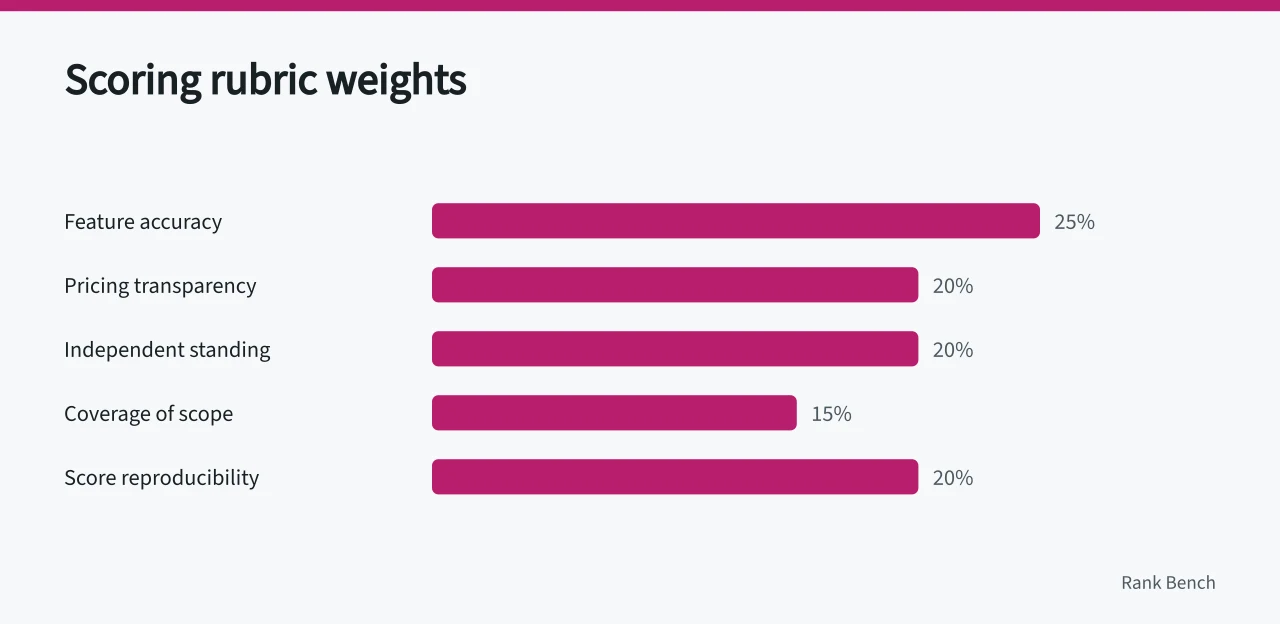
| Criterion | Weight | What earns full marks | Evidence needed |
|---|---|---|---|
| Feature accuracy | 25% | Named features match vendor documentation and public changelogs | Vendor docs, dated |
| Pricing transparency | 20% | Public price, billing unit and seat rules stated | Price page, dated |
| Independent standing | 20% | Claim is confirmed by a source outside the vendor | Regulator, contract or standard |
| Coverage of scope | 15% | Limits of the review stated, including countries and tiers | Scope note |
| Score reproducibility | 20% | Weighting published; a reader can re-run each score | Method statement |
Weightings are illustrative. A team buying for one market may put more weight on pricing than on international coverage. What matters is that the weights are published before scores are given, not chosen afterwards.
Cap any criterion that rests on a single vendor source. A capped score tells the reader the evidence is thin rather than hidden.
What this method does not assess
A document-based review cannot tell you how fast a crawl runs on your site, or how quickly support replies. Those need a trial on your own data. This method does not claim hands-on testing.
State who did the reading and when. That is not a credential claim, but it lets a reader judge whether the scope matched their use case.
Where a vendor publishes its own benchmark, cite it as a vendor benchmark with a date. Do not merge it with independent evidence, and do not give it the same weight. The SEO tools selection checklist in England turns the same evidence into questions for a demo call.